Response to the Statement Issued by Polish-American Organizations Regarding the 2025 Presidential Election in Poland
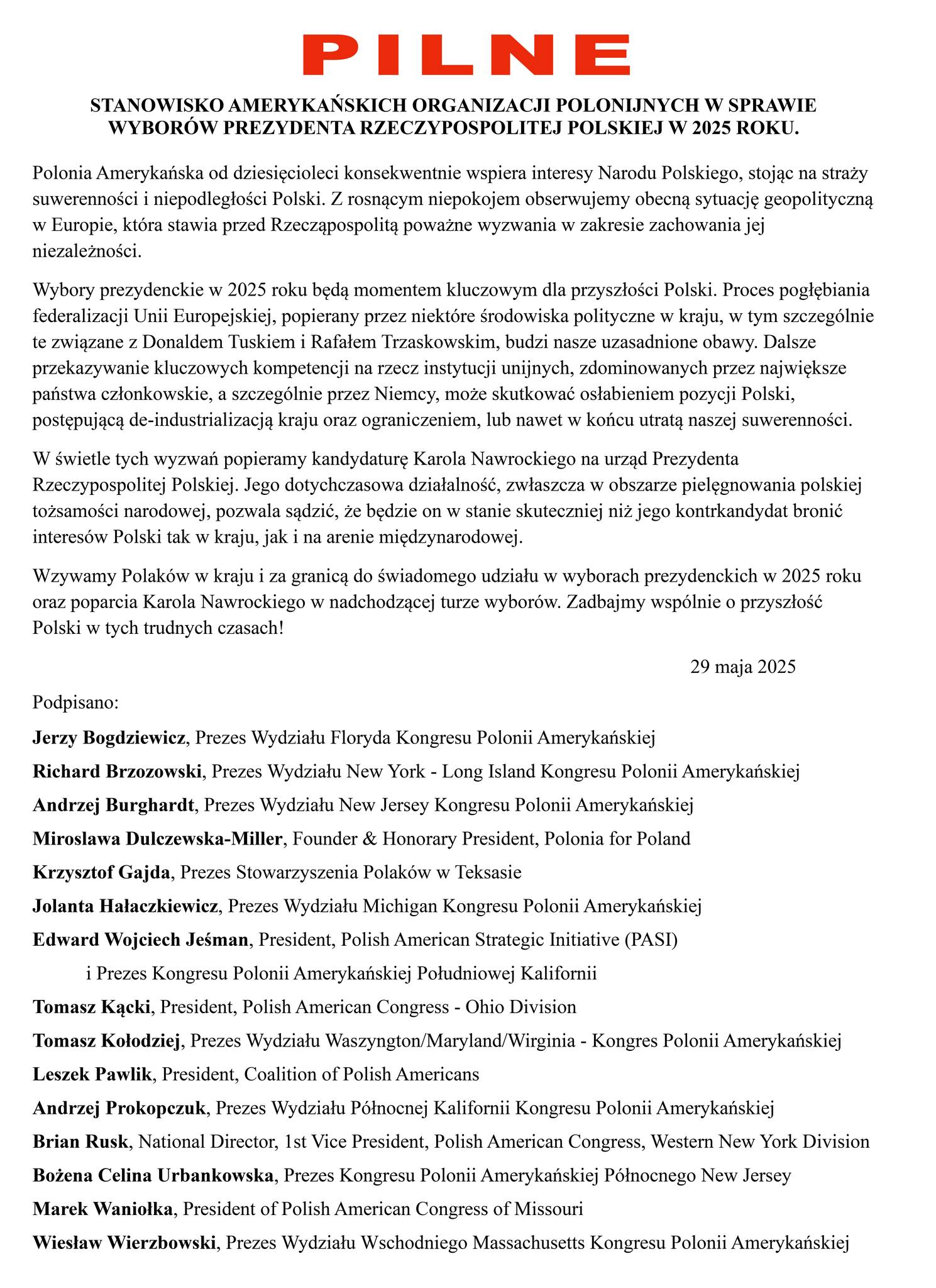
We, the members of Sokoły, find it necessary to respond to a statement issued by multiple Polish-American organizations endorsing Karol Nawrocki for the presidency of Poland. We reject the statement's narrative rooted in fear, division, and isolationism, and propose a different vision for Poland's future—one built on democratic values, social inclusion, and active cooperation within Europe and the international community.
Today, Russia’s aggressive imperialism is the single greatest danger to Polish sovereignty. Vladimir Putin's strategic goal is clear: to weaken NATO, divide the European Union, and reestablish a Russian sphere of influence in Central and Eastern Europe. In this context, EU membership is not just a matter of economics or regulation—it is a pillar of Poland’s national security, giving us a stronger position in a world increasingly shaped by global challenges such as military threats, climate change, and economic instability.
Yet, despite the tangible advantages of EU membership, we see a troubling rise in anti-EU sentiment—even among those who directly benefit from it. Many Polish farmers, for example, receive substantial EU subsidies, yet express opposition to the EU. This contradiction speaks to a deeper political and social disconnect that cannot be ignored.
Polish Americans must ask themselves: Is Poland truly not receiving enough from the EU, or are we simply failing to appreciate the contributions we do receive? The aftermath of Brexit should serve as a stark warning. The promises of sovereignty and self-sufficiency quickly led to economic disruption and political isolation. We must learn from this, not repeat it. The EU is far from perfect, but abandoning it or weakening our ties would only serve the interests of those who wish to see Poland vulnerable, divided, and alone.
We are particularly troubled by the growing involvement of MAGA-aligned figures in Polish politics. When U.S. political actors like Kristi Noem attend events like CPAC in Rzeszów and publicly endorse figures such as Nawrocki, it raises legitimate concerns about foreign political interference—ironically, the very kind of interference that the original statement claims to oppose when it comes from Brussels. If Polish-American leaders are truly concerned about external influence, then that scrutiny must be consistent. It cannot apply only to the EU or the so-called “liberal elites.” Sovereignty cannot be selectively defended.
This leads to a deeper question: What does it mean to be Polish in America? And who has the authority to define it?
The letter, signed by several Polish-American leaders, implies that Polish American identity is inherently conservative, anti-European, and aligned with a specific political faction in Poland. We reject that premise.
To us, being Polish American means rejecting simplistic narratives that divide so-called “true Poles” from supposed “traitors.” It means understanding that there is no single way to be Polish, and no one group speaks for all of us.
We reject the idea that Polish identity should be defined by one religion, one version of history, or one political ideology. That notion contradicts both the American experience and Poland’s own rich, multicultural past. We stand for a broader, more inclusive vision of Polonia: one that is democratic, engaged, and forward-looking—not trapped by nostalgia or dominated by reactionary politics.
Karol Nawrocki, former head of the Institute of National Remembrance (IPN), represents a narrow, nationalist vision that often distorts Polish history. His leadership will deepen ideological divides, curb freedom of expression, and steer Poland not toward sovereignty but toward a hybrid threat of being caught between Russia’s authoritarian influence and the polarizing culture wars exported from the American far right.
At the same time, our critique of Nawrocki should not be mistaken for an endorsement of Trzaskowski, the Civic Platform party, or Tusk's neoliberal economic agenda. We believe Poland deserves economic policies that do not just serve the privileged few. Neoliberalism has failed too many, both in Poland and globally, and cannot provide the foundation for an equitable and resilient society.
Original statement signed by leaders of Polish-American organizations: